Designing Adaptive Digital Mental Health Assessment and Self-Management for University Students: An Evidence-Informed Framework
Keywords:
Digital mental health, University students, PHQ-8, GAD-7, Self-efficacy, Technology acceptance, Adaptive interfaceAbstract
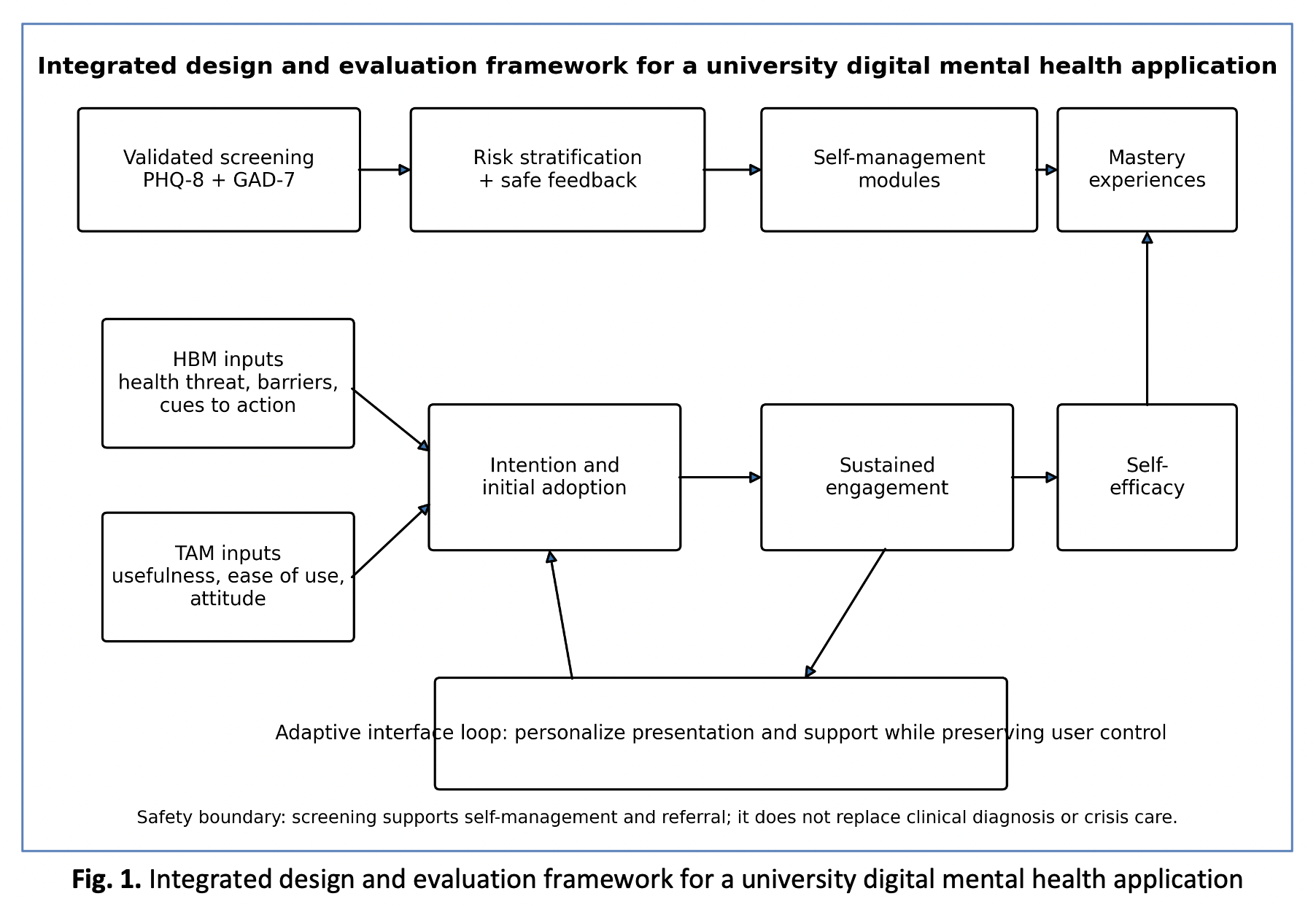
University students experience substantial psychological distress, yet digital mental health applications often struggle with sustained engagement and can blur the boundary between screening and diagnosis. This paper develops an evidence-informed design and evaluation framework for a university mental health assessment and self-management application. A targeted narrative synthesis was conducted using validated clinical screening literature, the Health Belief Model, the Technology Acceptance Model, and peer-reviewed studies of mobile mental health engagement, adaptive interfaces, and the published Mental Health Evaluation and Lookout Program (mHELP). The evidence indicates that screening should rely on validated instruments such as PHQ-8 and GAD-7, with explicit safety and referral pathways; engagement should be evaluated separately from intention; and perceived health threat, usefulness, ease of use, and resistance to change are important design variables. Published mHELP evidence further shows that self-efficacy can increase during digital coaching and may function as an outcome of mastery experiences rather than only as a pre-use predictor. The framework therefore integrates clinical screening, behavioural beliefs, adaptive interface design, self-management modules, and longitudinal engagement metrics within a safety boundary that prevents automated diagnosis or crisis management. The resulting model offers a defensible basis for future prototype development and prospective evaluation without misrepresenting previously published trial data as new evidence. Abstract Views: 12 PDF Downloads: 6