VisionCare: A Closed-Loop Digital Health System for Eye Health and Screen-Time Management in Children with ADHD
Keywords:
ADHD, digital health, eye-tracking, machine learning, screen-time managementAbstract
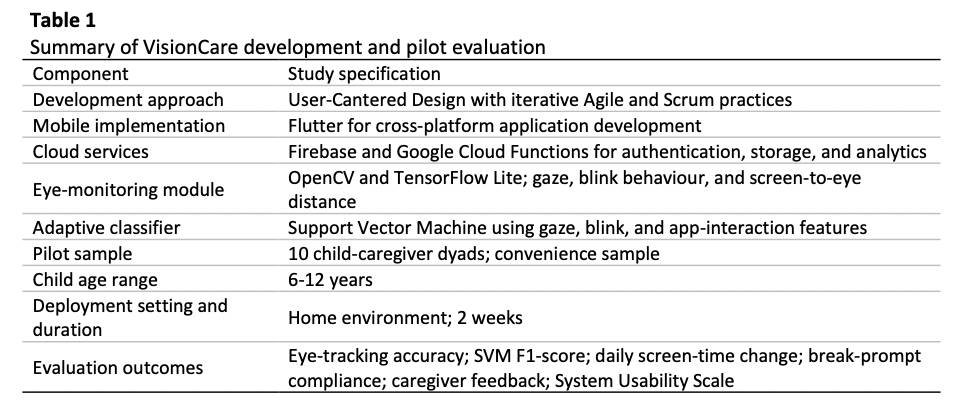
Attention-deficit/hyperactivity disorder can make self-regulation of digital device use difficult, while prolonged screen exposure may contribute to visual discomfort and fatigue. Existing digital tools commonly address behavioural management or eye health separately, leaving a gap in integrated, real-time support. This study aimed to design and pilot-test VisionCare, a closed-loop digital health system combining real-time eye monitoring with adaptive screen-time support for children with attention-deficit/hyperactivity disorder. The system was developed using user-cantered design and iterative Agile methods. OpenCV and TensorFlow Lite processed front-camera video for gaze and blink monitoring, while a Support Vector Machine classifier used gaze, blink, and application-interaction features to identify disengagement or fatigue states and trigger break prompts. A two-week home pilot involved ten child-caregiver dyads. Technical performance, daily screen time, break-prompt compliance, caregiver-reported outcomes, and System Usability Scale scores were assessed. The eye-tracking module reported 92% detection accuracy, and the classifier achieved an F1-score of 0.89. Daily screen time decreased by an average of 28%; caregivers reported improved break-prompt compliance and fewer eye-strain complaints; and the mean usability score exceeded 80/100. The findings indicate preliminary feasibility and usability, but the small convenience sample, short duration, and incomplete model-validation details require confirmation in larger longitudinal studies.